

“Sporting” Landscape
Subscriber Stephen Ryan on the financial challenges and missteps

“Those who talk about the club not having kicked on in Europe since 2003 ignore the enormous change in the financial landscape of football in that period.
It has created a gap which keeps growing and challenges any club playing in a smaller European league. Most supporters understand that. Of course, clubs can still punch above their financial weight, and we should aspire to that. But if you swing and miss, you risk the very stability of the club, and that would be profoundly irresponsible.”
That wasn’t all Ross Desmond said in his pre-prepared speech at the abandoned AGM, and I could spend an inordinate amount of time ripping it to shreds. However, when the Champions League group stage finished, this was the bit that stood out for me.
A league phase that witnessed Bodø/Glimt winning in Madrid to qualify, Qarabag getting through, and Club Brugge qualifying again. Now some people will jump in here to point out that neither Brugge nor Bodø won their titles last season: “surely domestic success is more important?”
Well, what happens when that domestic domination gets challenged, by smarter, more agile clubs? Brugge and Bodo could say their domestic success dipped as they progressed in Europe. Do we have that excuse?
Desmond is right in some respect – the landscape has changed – with the latter stages of the Champions League now clearly dominated by the big five leagues. It’s a super league in all but name, and the new format hasn’t changed that. Since the 2019-20 season only two clubs from outside that top five - Benfica and Porto - have made the last eight. Last season only six clubs from the lower leagues got out of the group, of which we were one. This year it was seven. Only three have made it both seasons. Brugge, Benfica and Sporting.
Let’s go back to 2003, which Desmond referenced. We had just lost in Seville, ending that season ranked at no 32 in UEFA’s coefficient table, and were the 10th best side in Europe that particular season.
In Deloitte’s money league we sat at no.18, ultimately rising as high as 13th in 2004, when we were ahead of both Spurs and Man City. That top 20 now only contains one side outside the top five leagues – Benfica. The rest are all the “big boys”. PSG, three German sides (including Stuttgart) and the big three in Italy and Spain, with the remaining nine English. Further evidence to support Desmond’s argument, right?
What about Sporting? One of the big three in Portugal, but very much the third, lagging behind Benfica and Porto in domestic and European achievements, and also financially.
They have won three of the past five titles, having previously not won it since 2002.
Last season was their most successful financially: €148m turnover and a profit before interest and tax of €45m as they returned to the Champions League. Very similar figures to Celtic actually, where we made €53m profit on €166m turnover (all figures in Euros).
Thanks to the excellent Swiss Ramble website you are actually able to do a deep dive and compare those figures – figures converted to Euros for comparison.
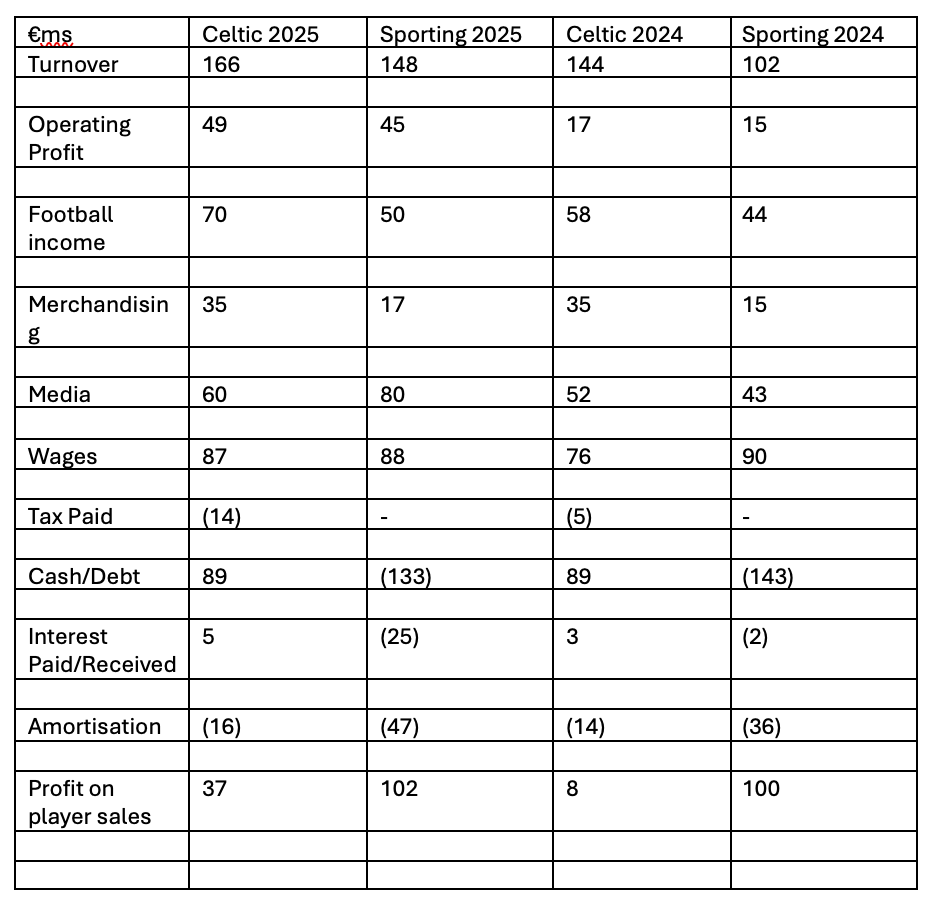
Now green and white hoops aren’t the only things we have in common. There are also similar challenges in being in a smaller country next door to a footballing superpower. Turnover is also similar, as is profitability. Wage bills aren’t too different either.
Both sides were title winners in both of the two seasons in question. Both have won a double during the period and both made it out of the CL league phase last season.
There are some stark differences however. Sporting are very much the third biggest club in Portugal, closing the income gap on Porto this season but still €80m behind Benfica.
Their profit from player sales is far greater. Our significant sales over the previous two years to June 2025 were Matt O’Riley, Kyogo Furuhashi and Jota for €70m. Sporting on the other hand sold Ugarte and Porro for €100m combined, and Chermiti (yes that one) for more than we sold Kyogo for.
The period in question also saw Sporting lose their manager, Ruben Amorim, to Manchester United, for which they received €11m. This doesn’t seem to have affected the club, further evidence of a structure that is set up to succeed.
Their amortisation at €41m p.a. - as opposed to ours at €15m - is reflected in the value of their squad. The cost is detailed at €226m, as opposed to €83m for Celtic. This is the actual transfer cost of the squad as at the financial year end 2025. Transfermarket currently has squad “values” of €468m v €141m in Sporting’s favour. They have a squad of 25, ours is 33.
We have a greater proportion of our income from match day income, i.e. the money from supporters’ pockets, similarly with merchandising. A reminder for the plc that football without fans’ money is nothing.
Sporting are operating with €133m of debt, while we sit with €89m in the bank. They pay interest on this debt, while we pay the tax man instead. This sees their team improve on the pitch, while ours regresses. They amortise the value of their squad while we again pay the tax man. Their asset value is on the pitch, not in the bank. Their market capitalisation is €206m, ours is €306m.
Obviously since those financial figures were published we have had a new season begin. I don’t propose to discuss Celtic’s as it has been done to death, and frankly I can’t wait for it to be over.
Sporting currently sit second, four behind Porto, having only lost once this season – at home to Porto, who they play away on February 9th.
It is in Europe where the greatest difference is evident, Sporting finished seventh in the CL league stages, putting four past our friends from Kairat as well as beating PSG.
That’s after a summer where they sold their talismanic star striker, Gyokeres, as well as a number of other first team players to the EPL and Bundesliga.
I anticipate next year’s financials will reflect a massive swing in Sporting’s favour, much of that self-inflicted by Celtic.
So how do we compete with a club with similar income and profitability to us? With a similar wage bill to us?
Even as a proud Glaswegian I have to admit that given the choice I would rather live in Lisbon, so it isn’t easy.
But Portuguese sides can easily attract Brazilians and South Americans I can hear some screaming. Sporting have two Brazilians in their squad, one of whom, Luis GIlherme, was only signed from West Ham in the recent window. Their recent signings have instead come from Spain, Greece, Belgium, Denmark, Mexico and the Czech Eepublic, rather than South America. As Spanish and English clubs have hoovered up South American talent directly they have looked to other markets, with Scandinavians such as Gyokeres and Hjulmand proving to be hugely successful acquisitions. They sell big, but buy big, now regularly spending more than €10m on players. The success of that is measured in their squad value which has roughly doubled against the actual cost in their accounts.
Given the wage bill isn’t massively different maybe the key is fewer players, of more quality, at higher wages than we currently pay. Rodgers always wanted a smaller squad.
Portuguese players being better than Scottish is a fair point, but we won’t pay top dollar for Scottish players. Imagine we had bought Lennon Miller in the summer and assimilated him into our squad, we’d have been better prepared to accept the offer for Arne Engels in the January window.
Half their squad is Portuguese. They have Belgians, Greeks, Japanese, Danes and Georgians - these are not players we can’t afford to buy. We just need to buy smarter.
Personally I see no reason why we can’t compete here. It’s all down to a willingness to compete. Comparison on both clubs’ finances by Swiss Ramble shows that we are well inside UEFA’s FSR regulations. Sporting aren’t any bigger than Celtic, they just have bigger ambitions. They aren’t scared to swing and miss.
As you may recall, at the recent abandoned AGM one of the proposals put forward by the Celtic Trust was for the “preparation and publication of a detailed report and 3-5 year plan covering football, financial and strategic matters” This gained only 1.14% of votes, the largest vote against the board at the AGM, but it was still pretty depressing that almost 99% of shareholders who voted - around 25% of those outside Desmond’s voting block - didn’t want this. Why wouldn’t we want to know what the plan is, shouldn’t we have a plan?
Sporting have a 135 page document on their website, with their 10 year strategy. This includes plans on stadium and infrastructure improvement, merchandising opportunities and numerous other areas to concentrate on. It’s there for all the world to see. More importantly their supporters can see and buy into a plan. (Page 111 is particularly interesting, fans have the ability to sell back their ticket for games they can’t make.
https://scpconteudos.pt/sites/default/files/scp_futureiscoming_24_34_en.pdf)
This should be required reading for every current and future board member at Celtic. Perhaps Dermot could read it to Ross at bedtime?
Yes Ross, the “Sporting” landscape has changed, now do we concentrate on what we can’t do or instead look at what we can do?
A great piece. And very constructive. Hopefully, the Celtic heirarchy will take the time to read it.